


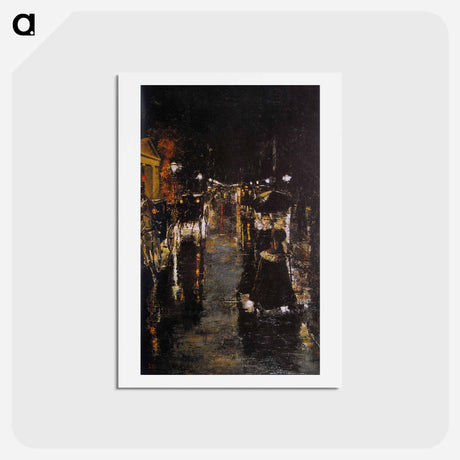
Leipziger Straße - Lesser Yury Poster.
Leipziger Straße - Lesser Yury Poster. - A5(148×210) / none is backordered and will ship as soon as it is back in stock.
【出荷予定について】
※土日祝定休
製品説明
製品説明
Artgraph. Original masterpiece art posters & art frames
Printed on high-quality paper manufactured by Epson, the same quality used in art works.
This paper was developed specifically for artwork, and is resistant to deterioration and fading, making it a category of giclee prints that are the highest quality among interior posters.
The texture, similar to that of art paper, gives the print a three-dimensional feel, making it a reproduction that looks just like the real thing.
- Paper weight: 190 g/m²
- Giclee print (inkjet print)
- The width of the margins is adjusted depending on the work and size.
*If you order a size that will result in printing being too rough due to the size of the original data, we will contact you.
*If you require a size larger than the sizes listed, please contact us directly.
| Work name | Leipziger Straße ) |
| Author name | Leo Lesser Ury |
| Production date | 1889 |
| Related keywords | This Lesser Lily (Ra) German Impressionist 19th and 20th century cityscape, night view, art poster, art panel, interior design, stylish painting, masterpiece, landscape painting, miscellaneous goods, vintage, retro, entryway, living room, dining room, bedroom, kitchen, bathroom, entryway, etc. It can also be used as a display reproduction for model rooms, offices, shops, hotels, cafes, etc. It also makes a great gift for housewarmings, birthdays, and other celebrations. |
| Related Keywords | |
| Management number | 1-5 |
※製品画像はできる限り実物の色に近づけるよう徹底しておりますが、 お使いのモニター設定、お部屋の照明等により実際の製品と色味が異なる場合がございます。
素材ごとに異なるニュアンスが生まれることもございますが、風合いとしてお楽しみいただければ幸いです。
余白と寸法
余白と寸法
縦横比によって、寸法が成り行きで縮小します。
詳細の寸法はお手数ですが、お問合せください。
| size | Minimum margin on the short side | Minimum margin on the long side |
|---|---|---|
| A5 | 14.5mm | 25.5mm |
| A4 | 20mm | 35mm |
| A3 | 28.5mm | 49.5mm |
| A2 | 40mm | 70mm |
| A1 | 50mm | 90mm |
| B5 | 17.5mm | 30.5mm |
| B4 | 24.5mm | 43.5mm |
| B3 | 35mm | 61mm |
| B2 | 45mm | 80mm |
| B1 | 64mm | 114mm |
*The above figures are the minimum margin widths.
Depending on the proportions of the work, such as long and narrow works, there may be more margins than those listed above.
If you would like to know the exact size in advance, please contact us here .
お届けについて
お届けについて
出荷までの期間はポスターのみは3営業日、額装込み・キャンバス製品は10営業日程度いただいております。
それ以外の製品は10〜14営業日程度いただいております。
営業日:月〜金曜
定休日 : 土・日曜日・祝日
※サイズ・色・点数によってお届けに通常より長くお時間をいただく場合がございます。お急ぎの場合や複数点数のご購入をご検討の場合は事前にお問い合わせください。
返金・交換について
返金・交換について
返金・交換に関して
到着した製品に不具合がございましたら到着より7日以内に速やかにご連絡ください。
■返品・交換などの連絡先
info@artgraph.jp
返金
商品に不具合が有った場合は上記「返金・交換」をご覧下さい。
キャンセル
生産開始前であればキャンセル・返金可能ですが、生産が終了している場合は全額ご請求とさせていただきます
詳しくはこちら

Leipziger Straße - Lesser Yury Poster.
安心してご注文いただけます。
Payment methods
artgraph.では運営側でクレジットカード情報を保存せず、お客様のクレジットカード情報にアクセスすることはできませんので安心してご利用ください。

Leo Lesser Ury
Juri Lesser was a German impressionist painter and printmaker active from the late 19th century to the early 20th century. He is particularly known for his poetic portrayals of urban scenes, such as Berlin cityscapes, rainy days, twilight scenes, and nighttime cafes, skillfully capturing the effects of light. Also known as the "painter of Berlin," his works possess a unique atmosphere and sense of color, reflecting the hustle and bustle and loneliness of urban life at the time.
Lesser Yuri Biography
- He was born on November 7, 1861, in Birnbaum, Posen province, Kingdom of Prussia (now Miedźchúd, Poland) to a Jewish family.
- Around 1872, he moved to Berlin with his family.
- In 1879, he enrolled in the Düsseldorf Art Academy and began studying painting. He then continued his training in various parts of Europe, including Brussels, Paris, Stuttgart, and Munich. In Paris, he studied under Jean-François Raffaelli and Gustave Boulanger, and was influenced by the Impressionists.
- He returned to Berlin in 1887 and continued to work there. At first he painted traditional subjects, but gradually he began to focus on urban landscapes, especially Berlin's street corners, cafes, and night views.
- In 1893, he participated in the exhibition of the Society of Eleven, which included Max Liebermann.
- In the early 1900s, he exhibited at exhibitions of the Berlin Secession, but due to his difficult personality he maintained a certain distance from the mainstream art world.
- Although he enjoyed some recognition during his lifetime, he never achieved the widespread fame of his contemporary, Max Liebermann.
- In 1921 he became a member of the Berlin Academy of Fine Arts.
- He died in Berlin on October 18, 1931, at the age of 69. After his death, although his works were not deemed "degenerate" under the Nazi regime, because he was a Jewish painter, they disappeared from public view, and many of them were scattered or destroyed.
Representative works
- Berlin Street in Rain (prolific production, especially in the 1920s)
- "Unter den Linden" (many works)
- Potsdamer Platz by Night (1920s)
- "Im Café Bauer" (Many produced, especially from the late 1880s to the early 1900s)
- Jerusalem (series of biblical landscapes, 1920s)
- "Self-Portrait" (many produced)
The Art of Lesser Yuri
While a part of German Impressionism, Lesser Jurij's art is characterized by his own unique poetic sentiment and urban sensibility. He preferred to paint the landscapes and atmospheres of modern cities, such as the hustle and bustle of the metropolis of Berlin, the gleam of rain-soaked streets, the nightscapes woven by gas lamps and car headlights, and the bustle of bustling cafes. While his brushstrokes are sometimes quick and show the Impressionist trait of attempting to capture fleeting impressions of light and color, he also exhibits a more subjective and emotional approach to his subjects.
He particularly explored the effects of light under specific weather conditions, such as rain, fog, and twilight, creating melancholic and poetic scenes. His "Rain in Berlin" series is his most famous theme, depicting light reflected on wet roads and people passing by under umbrellas with a unique sense of color. He excelled in both oil and pastel, and the soft texture of these works contributed to enhancing the atmosphere of his works. In his later years, he also painted biblical scenes and landscapes of his hometown, but his most acclaimed works are his cityscapes of Berlin. His works capture the atmosphere of Berlin from the end of the century to the Weimar Republic period, alluding to the loneliness and transience of people living in modern cities.
Lesser Yuri's influence and later recognition
Although Lesser Jurij was highly regarded by art lovers and critics in Berlin during his lifetime, he never achieved the leading position or widespread fame of his contemporaries, especially Max Liebermann. This is said to have been due in part to his difficult personality and tendency to isolate himself.
After his death, with the rise of Nazi Germany, Jurij, who was Jewish, suffered the tragic fate of having his works removed from public collections, exported overseas, or even destroyed, which meant that his name was temporarily forgotten in art history.
However, after World War II, especially since the 1970s, Jury Lesser's art has been rediscovered and reevaluated. His Berlin scenes have come to be recognized as evoking memories of a lost city and as important examples of the diversity of Impressionism. Today, Jury Lesser is internationally acclaimed as a painter who established a unique position within German Impressionism and for his poetic portrayal of urban life in Berlin in the early 20th century. Keywords such as "German Impressionism," "Berlin streetscapes," "night scenes," "rain scenes," "light effects," and "pastel paintings" are important elements in understanding Jury's art. His works are housed in museums throughout Germany and around the world and continue to fascinate many.
Recommend

Leipziger Straße - Lesser Yuri Phone Case.

Am Bahnhof Friedrichstraße - Lesser Yury Phone Case.

Weiher bei Einbruch der Dunkelheit - Lesser Lily Memo.

Portrait of Dr. Fritz Rathenau - Lesser Yuri Memo.

Dame vor Pferdedroschke im Tiergarten - Lesser Yury Memo.

Dame und Herr im Restaurant - Lesser Yury Memo.

Boulevard in Paris - Lesser Yury Memo.

Train station Nollendorfplatz at night - Lesser Yuri Memo.

Tiergartenallee mit Siegessäule - Lesser Yury Memo.

Berliner Straße mit Droschken in Regen - Lesser Yury Memo.

Unter den Linden - Lesser Lily Memo.

Hochbahnhof Bülowstraße - Lesser Yury Memo.

Self-portrait - Lesser Yuri Memo.

Vor dem Café (Berlin bei Nacht) - Lesser Yury Memo.

Unter den Linden im Regen - Lesser Yury Memo.

Nächtliche Straßenszene, Berlin - Lesser Yury Memo.

Mutter mit Kind auf einer Strassenkreuzung - Lesser Yury Memo.

Lady in the loge - Lesser Yuri Memo.

Galerie im Café Vaterland am Potsdamer Platz, Berlin - Lesser Yury Memo.

Damen, einer Droschke entsteigend - Lesser Yury Memo.

Dame mit Kind im Tiergarten (Berlin) - Lesser Yury Memo.

Brücke über den Landwehrkanal - Lesser Yury Memo.

Berliner Straße im Sonnenschein - Lesser Yury Memo.

On the channel - Lesser Yurii Memo.

Feldarbeiter In Thüringen - Lesser Yury Memo.

Der blaue Berg - Lesser Yury Memo.

Berlin street scene with horse-drawn cabs - Lesser Yuri Memo.

Am Kurfürstendamm - Lesser Yury Memo.

Lady in a black evening dress with a green scarf - Lesser Lily Memo.

Abraham Geiger - Lesser Yuri Memo.

Spring - Lesser Lily Memo.

Herbstliche Bachlandschaft im Abendlicht - Lesser Lily Memo.

The Red Carpet - Lesser Yuri Memo.

Nachtbeleuchtung - Lesser Yury Memo.

Frau und Droschke - Lesser Yury Memo.

Woman at writing desk - Lesser Yuri Memo.

Im Café Bauer - Lesser Yury Memo.

Abend im Café Bauer - Lesser Yury Memo.

Im Café Bauer - Lesser Yury Memo.

Häuser am Fluss mit einer waschenden Frau - Lesser Lily Memo.

Tiergarten im Winter - Lesser Lily Memo.

Sonnenuntergang am italienischen See (Oberitalien) - Lesser Yury Memo.

Oberitalienischer Gebirgssee - Lesser Uly Memo.

Küfermeister Adam Chaudy - Lesser Yury Memo.

Nollendorfplatz bei Nacht - Lesser Yury Memo.

Lying Nude - Lesser Yuri Memo.

Leipziger Straße - Lesser Uly Memo.

Unter den Linden nach dem Regen - Lesser Yury Memo.

Am Bahnhof Friedrichstraße - Lesser Juri Memo.

Im Café Bauer - Lesser Yury Memo.




本日のご注文受付終了まで
時間が過ぎると翌営業日のご注文扱いとなりますのでご了承くださいませ。
同じ作品を使用したアイテム
-

Leo Lesser Ury(レッサー ユリィ)
Leipziger Straße - Lesser Yuri Phone Case.
Sale price From ¥3,480 Regular price ¥4,280Unit price /Unavailable -

Leo Lesser Ury(レッサー ユリィ)
Leipziger Straße - Lesser Uly Memo.
Sale price ¥2,800 Regular price ¥3,480Unit price /Unavailable -
Leo Lesser Ury(レッサー ユリィ)
Leipziger Straße - Lesser Yury Postcard.
Sale price From ¥780 Regular price ¥1,100Unit price /Unavailable


